



My Life in Cotton, Or, How I learned to Predict the Future, Guest blog post from Chris Ackiss, Posted on Monday, December 1, 2025
- December 1, 2025
- |
- Posted By: Scott Family Collection
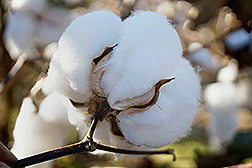
image credit: usda.gov
Back in the 1990’s my plan was to work in the tobacco business after I graduated from college. And I did find a job with a tobacco warehouse, but this work is seasonal, so when the market ended, so did my job.
My next job was in the cotton business, which as it turned out, was seasonal also.
From about September until a little after February I had a job in Wilson, North Carolina. I stood in a chilly warehouse all day, checking in truckloads of cotton.
I learned a great deal about cotton from that job.
After the farmer harvests the cotton, it is packed into modules which typically weigh several tons. The modules are loaded onto a special truck and shipped to the gin to be cleaned.
Modern day cotton gins are similar to the one originally designed by Eli Whitney. They are just faster and more automated. The ginning process removes most of the trash and seeds from the raw cotton. The seeds can be fed to cattle or processed into cotton seed oil.
The cleaned cotton is packed into 500-pound bales, ready to be shipped to a warehouse. Before being loaded onto a truck, the cotton is sampled for grading.
One half of the sample goes to the government grading office; the other goes to the warehouse where the cotton will be stored. The warehouse stores the cotton until it is time to go to the mill. Running a warehouse is a competitive business. The farmers have a choice of where to take their cotton; the warehouses rely on the revenue they get for storing the cotton until it is sold to the mills. When the cotton is sold, it gets sent to the mill to be made into cloth and then clothing.
I learned a lot about cotton from that job in the warehouse. How it is grown, harvested, ginned (cleaned) and sold. But by the end of February, I was looking for a job again. I liked working in cotton and was pleased to find another job in the cotton industry, this time at a mill.
Did you know that cotton comes in different colors? Well, I do now.
As I said, my next job was at a cotton mill. In order to be good at my new job, I needed to learn a great deal more about cotton.
To prepare me for my job, my new bosses sent me off to school for ten weeks.
The first class was held at Texas Tech. There I was trained on grading cotton. The training class lasted for two weeks and then I went to Rhodes College in Memphis, TN for eight weeks to learn everything I could about the entire process from planting to consumption. This was a wonderful experience. The students were from all over the world. Cotton is big business, after all! While at HVI school at Texas Tech I was in the panhandle of Texas. Lubbock to be exact and it is a cattle town for sure with a stock yard. When the wind blows you can smell the stockyards all over town. While the food was good, I prefer eastern NC BBQ. However, if you are ever in Memphis there is a place for ribs called the Rendevous. It is a must.
After my training, I was able to help the mill a lot and became a quality auditor for a short period. I would go out to the mills that we owned, I think it was like 5, and do audits on the laydowns that we shipped from the cotton warehouse to the mill to make sure they were using the cotton as planned.
I did not stay in the cotton business, but the entire experience prepared me for other jobs that required great attention to detail, quality control, and the ability to anticipate the future (not predict, just anticipate). But more about that later.
Aunt Mamie Says Hello, Posted on Monday, November 24, 2025
- November 24, 2025
- |
- Posted By: Scott Family Collection
One of the great things about living in an old house is, of course, the attic. The attic is the place where families store things they no longer use, but which are too precious to discard.
When I was about six years old, my family moved from a tidy tract home to a Victorian monstrosity across town in the old section of our town in New Jersey.
I was not in favor of moving but our family had outgrown our old place, which we referred to as The Little House. And it was just that, little. Too little for my parents, my two brothers, my grandfather, and our collie dog, Roscoe. We called the new place 19 Maple as that was the address.
19 Maple had a lot of advantages, as least as far as my parents were concerned. It had four bedrooms, and it was within walking distance of my father’s job in the City Hall. The train station, library, and movie theater were conveniently located right down the street. Everything we needed was within walking distance, or just a bike-ride away. It really was a great place to spend my childhood.
I will never forget my first look at what turned out to be my family’s home for the next thirty-six years. The place seemed enormous, and it was. It was almost 3000 square feet with a full basement and attic.
And what an attic it was! It had a solid floor, was divided into rooms, and had electricity. We could have rented it out but for the fact that there was no bathroom, something future owners probably remedied. But I digress.
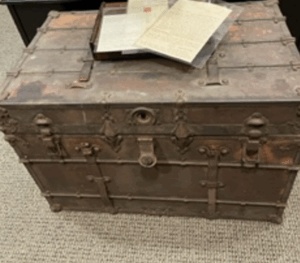
The day we visited, a bright sunshiny day in August, I noticed a traveling trunk located in a corner of the attic. I wanted to open it but my mother claimed it was locked. She was probably concerned that my brothers and I would take turns climbing into it and get stuck.
I never found out what was stored in that trunk; it was gone by the time we moved in. Even today, I can’t help wondering what amazing things might have been stored there by the people who had lived there before us.
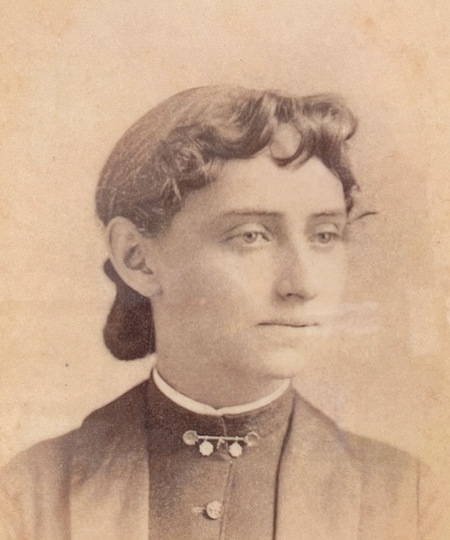
We have a trunk just like the one I saw in my attic here at the Scott Family Collection. It sat in the attic of the Scott home place for decades, accepting all manner of treasure, stored there lovingly by Mamie White Scott, who died in 1953 at the age of 88.
Mamie is one of my heroes. She understood perfectly that someday, the flotsam and jetsam of everyday life would be of great interest to people not yet born. A way for us to peer into the past and see how people in her day lived their lives. I can picture her placing yet another treasure in the trunk and then smiling, wondering who would find it years later.
A lot of the things Mamie stored so carefully in her attic trunk are now on display at the Scott Family Collection. We are open Tuesdays, Wednesdays, and Thursdays, from 8 AM to 4 PM.
The past is beckoning; what are you waiting for? Oh, and by the way, Mamie says hello.
The Check is Not in the Mail, Posted on Wednesday, November 12, 2025
- November 12, 2025
- |
- Posted By: Scott Family Collection
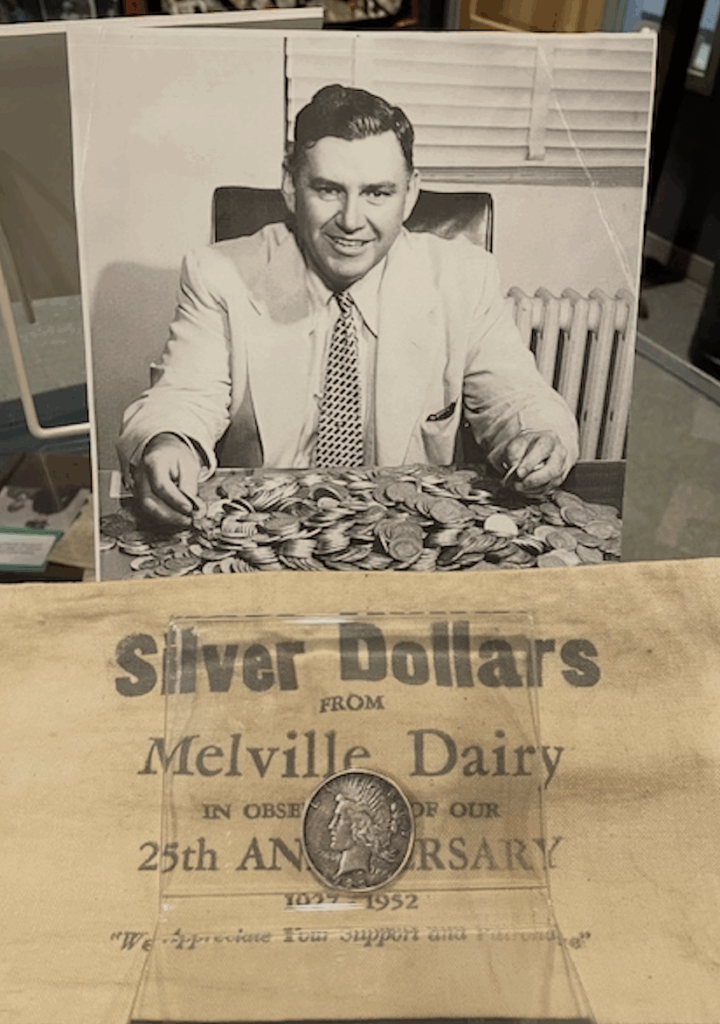
One of the most interesting items in the Scott Family Collection is a simple silver dollar. The dollar is part of the Melville Dairy display, and it is placed right next to a photograph of Ralph H. Scott, one of the founders of Melville Dairy. In the photograph, Ralph is sitting at his desk behind a huge pile of silver dollars some of which were used to meet payroll for the month of August, 1952.
In fact, I should say two payrolls, one for the plant employees and one for the farmers who supplied their milk to the dairy.
Why on earth would a modern, state of the art milk processing plant choose to meet a monthly payroll using coins?
Well, the explanation is simple. Despite promoting the dairy as a simple, local, home town dairy, which of course it was, Melville Dairy was, in fact, a huge contributor to the economy of Alamance County. In a single month, 60,000 dollars flowed from the two dairy payrolls into the economy of Alamance County.
But how to make this contribution visible?
Well, silver dollars were a rarity back then. According to Otis Lackey, former Assistant Manager of Melville Dairy, you did not encounter silver dollars much in your daily life. So the appearance of so many of them all at once all over Alamance County, was a way to get noticed.
The coins were ordered from a bank in Charlotte and they were delivered to the Burlington Post Office. A Melville Dairy truck picked them up from the Post Office and delivered them to the plant. The coins were sorted into bags and used to pay the plant employees and the farmers. People used the coins everywhere, and they began to pop up in cash registers all over the county.
Even today, 73 years later, many visitors to the Scott Family Collection will stop in front of the display and tells us excitedly how a relative who worked at the dairy saved out some of their silver dollars to give them to family members as mementos.
Now that is great marketing!
Pulling and Selling Tobacco in the Late 20th Century, guest blog post by Chris Ackiss. Posted on November 4, 2025.
- November 4, 2025
- |
- Posted By: Scott Family Collection
Although my parents both came from families living in Rocky Mount, North Carolina, they did not meet until college. Mom’s father worked for Kingsdown, the company his father had founded in 1904. Dad’s father had received a promotion which required him to move his family to the same town.
My father was in the Air Force for the first part of my life which is why, despite my Southern roots, I was born in Japan.
When my father got out of the Air Force, we moved to Raleigh so he could further his education at NC State. He planned on going to Carolina for law school but the family kept growing and so instead, he went to work for Georgia Pacific. We lived in Raleigh until 1977 when Dad got a new job in Asheboro.
Asheboro is not Raleigh. Back then, it was a small industrial town with about 12,000 residents. There wasn’t much to do when school let out for the summer. My buddies and I couldn’t drive yet, so we spent a lot of time hiking around Back Creek Mountain. We all did odd jobs, cutting grass, cleaning yards, and collecting bottles for money.
Freedom came when one of my friend’s older brother David got a new car, a Pontiac GTO. It was green with a white vinyl roof; the seats were white as well. That car was fancy, fast, and sharp!
It was David’s idea for us to work in the tobacco fields. We had to get up early, because work on the farms in Ramseur began at 5:30 and it was a 30 minute drive.
You might be wondering why a boy who was born in Japan and raised in Raleigh would be interested in pulling tobacco. In fact, my family on both sides were farmers going back to the 1700s. I was curious to find out more about my Southern roots. And, it didn’t hurt that we would be paid every day at quitting time.
Picking tobacco is no joke. We wore long sleeves to avoid getting tar and nicotine on our arms. Also the plants were soaking wet with dew. You walked bent over up and down the rows, grabbing the lowest three or four leaves on each plant (the sand lugs, or primings as they were called) and snapping or “pulling” them off. When you got an armload, you carried them over to a sled attached a tractor. And you did this over and over again, moving from field to field, farm to farm, until it was time to go home. Before we left for the day, we had to wash with Lava soap to scrub all of the tar off.
When full, the sleds were driven to the barn where the women and girls were in charge of hanging the leaves up to dry. If it was a stick barn, they had to wrap the leaves around a pole and then climb all of the way up to the rafters to suspend the poles from the beams.
Our breaks consisted of nabs or a moon pie and a Coke (RC cola). The day started early and ended at noon, when it was too hot to continue working. We got paid every day in cash, often spending some of it on lunch. We gave some of it to David, to pay for gas, but there was always a bit left over for us boys.
I went away to school in Virginia, and did not encounter tobacco again until years later. By the time I was in college, I was looking around for a career.
My parents introduced me to a friend who was a Vice President at Universal Leaf. My interest in my family history of farming resurfaced, and for a season I worked in a tobacco warehouse called The Liberty. When I was offered a job I bit like a catfish with a mouth full of chicken livers. Catfish really do love chicken livers, in case you were wondering.
But back to the job.
I was hired as a weighmaster, weighing all the “sheets” as they were called and prepping the bales for sale. The farmer would present me with a card that had pounds written on the card. I would deduct the pounds being weighed from the card. Each farm had its own card. When the card balance reached zero, the farmer had used up his allotment, even if he had more tobacco available. All of the “sheets” went down to the sales floor in the order that I weighed them. This way, when the auction was going on, the farmer could be present when his crop was sold.
My other job at the warehouse was as a ticket handler on the sales floor. The ticket handler’s job was to hand the ticket on each bale to the ticket writer. The ticket writer interpreted the auctioneer’s chant and wrote the grade, the purchasing company, and the price the bale brought all on the ticket. He would flip the tickets off his clipboard as he walked along; the tickets would land perfectly on each bale.
The sale had a cast of characters, with each one having their own role. The buyers walked on one side of the row with the farmer; the auctioneer, warehouse owner, ticket handler and ticket writer walked on the other side. It seemed like a battle. You did this with several breaks, until the whole warehouse was done. At day’s end, the bales would be sorted by purchaser and moved by dolly onto the trucks that would deliver them to the buyer’s processing plant. And you did this every day until the sale was over.
I never did pursue a career in tobacco, but I did train as a cotton grader. But that, as they say, is another story.