



Surprise, Surprise! Posted on February 10, 2026
- February 10, 2026
- |
- Posted By: Scott Family Collection
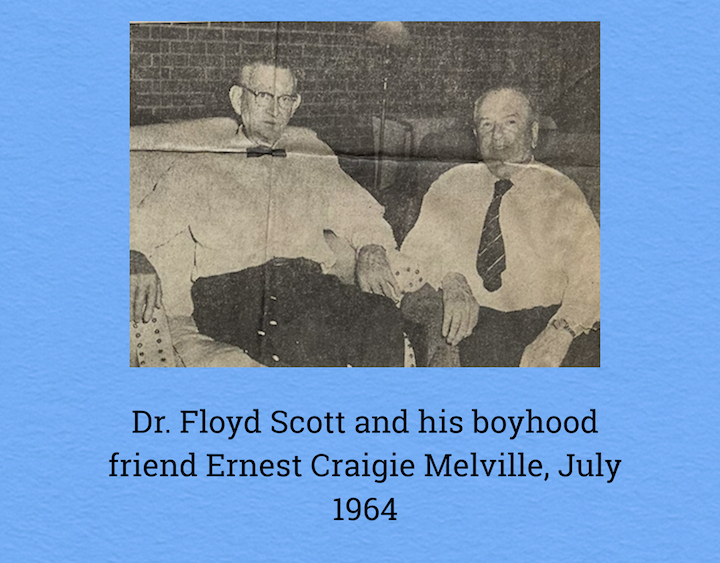
Having a summer birthday has its good points. The weather is nice, and you can have your party outdoors. However, if you were hoping to have a big crowd, everyone might be on vacation.
Not the case for Dr. Floyd Scott, who turned 70 in 1964. His family arranged for a surprise family birthday party for him at his home in Union Ridge, Alamance County, North Carolina. It is a good thing that his birthday was in the summer, because there were more than 100 guests!
Dr. Scott was of course the guest of honor. Everyone is at their own birthday party. But there were some other special guests as well.
One was Governor Terry Sanford, one was Ernest Melville, and one was Ernest’s granddaughter.
We all know who Governor Terry Sanford was, but what about the Melvilles?
The Scotts and the Melvilles go way back.
In 1907 a group of twenty young men from Scotland boarded the Astoria, a ship bound for America. They were sent to families around the United States, to work and to learn about farming. One of the names on the list was chosen by Robert W. Scott. Robert did not know Ernest, but he was intrigued by the boy’s last name, which was Melville, the same as Robert’s farms. Ernest stayed with the Scott family for almost a year before starting a career in Boston, Massachusetts.
Ernest was deployed all around the world during World War I. He was a witty and insightful correspondent, sending letters to family and friends when he could. Some of the letters he sent were to Floyd and his siblings. The Scotts and the Melvilles kept in touch over the years, and Ernest was pleased to see Floyd again in 1964. Ernest passed away only two years later, so this was a very special visit. I wonder what kind of cake was served? I think I might know. I was told Dr. Floyd’s favorite cake was caramel.
Mebane Triumph, Posted on February 4, 2026
- February 4, 2026
- |
- Posted By: Scott Family Collection
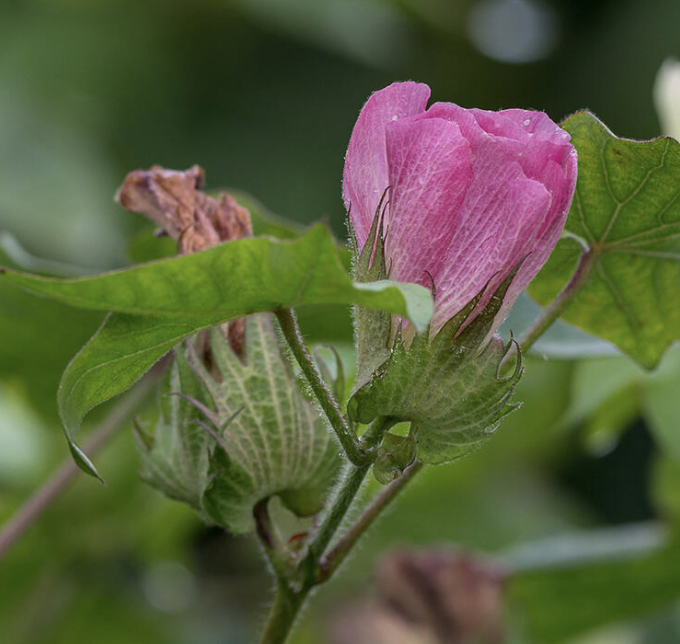
Photo credit: Cotton flower, Mississippi State University, University Extension
What in the world is Mebane Triumph?
The Mebane family has accomplished so much over the last several hundred years, it would be hard to guess which of their triumphs I am referring to.
So, you might be surprised to find out that Mebane Triumph is a variety of cotton!
It was developed by Alexander Duff Mebane (1855-1923), a descendant of a brother of General Alexander Mebane, Jr. who served in the Revolutionary War.
Alec as he was called, was born in 1855 in what would become Mebane, North Carolina, a small city that straddles Alamance and Orange Counties.
His parents, David Mitchell Mebane and Elizabeth Kerr Mebane moved the family to Dancyville, Tennessee, where they lived through the Civil War.
Around 1870, the Mebanes moved again, this time to Texas. They built a two-room cabin and resumed farming.
Alec was a farmer, but he also bred horses, a venture that ended in a disastrous fire. He returned to farming and by luck, observation and skillful plant breeding developed a variety of cotton that was sold all over the world. He marketed his new variety as Mebane Triumph Cotton.
What is an Indenture? Posted on January 28, 2026
- January 29, 2026
- |
- Posted By: Scott Family Collection

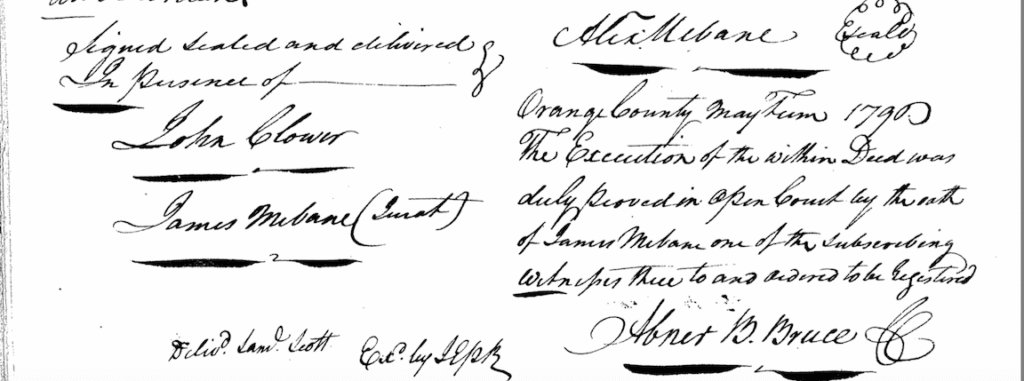
In the fall of 1793, Alexander Mebane and Samuel Scott signed an indenture in which Alexander sold 200 acres of land along the Haw River to Samuel. James Mebane was one of two witnesses to this transaction.
Here is a photo of the top of the document, which was entered into a bound volume at the County Clerk’s Office. The page number is visible at the top: 458. The bottom of the document shows who was present at the signing.
The word, “indenture” is not one we use all the time. When I looked it up, the definition was given as a legal agreement, contract, or document.
Samuel and James (the witness) were about the same age and most likely good friends by this time.
Because, less than a year later, when Samuel decided to get married, James stood up for him as bondsman.
The friendship must have endured, because years later, Samuel named one of his sons James Mebane Scott.
Guilty Pleasures, Posted on January 20, 2026
- January 20, 2026
- |
- Posted By: Scott Family Collection

One of the guilty pleasures afforded to historians is the chance to read the private correspondence and diaries of people who lived long ago.
Recently, I found a letter posted in December of 1945, while the United States was at war.
The letter was addressed to Mary Kerr (Mrs. John T. Kerr, Sr., 1864-1947). It was from her niece Gertrude who lived in Canada at the time.
The letter included an update on Mary’s brother (Gertrude’s father) who was in the hospital with a duodenal ulcer. Apparently, he was feeling much better and would be discharged soon. She suggested that if Mary wanted to cheer her brother up, some cigars would help. He was contemplating a vacation to Florida but didn’t want to go alone, she added.
Mary was expecting a lonely Christmas as her husband had passed away in 1940 and her son, John T. Kerr III was away in the Navy. So a trip to sunny Florida would be a nice diversion.
I wonder if Mary took the hint.