


Do You Know What Cadastral Means?, Posted on October 8, 2026
- October 8, 2026
- |
- Posted By: Scott Family Collection
Do You Know What Cadastral Means?, Posted on October 8, 2026
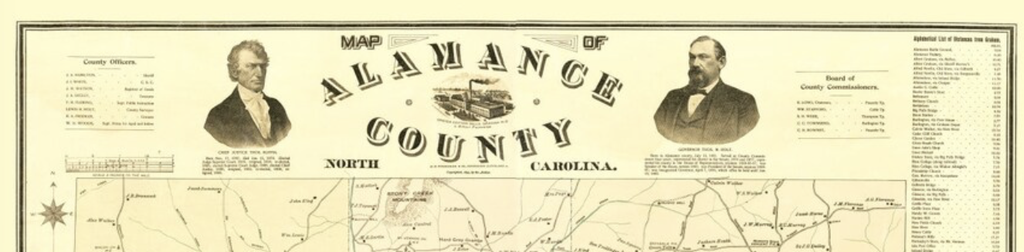
I encountered the word “cadastral” while researching a huge map that hangs on the wall opposite my desk at the Scott Family Collection. Its an odd word and one I had never seen before.
According to the Merriam-Webster Dictionary, cadastral “is an adjective that means of, relating to, or showing the extent, value, and ownership of land, typically for the purpose of taxation or legal documentation.”
The map in my office was prepared by William Luther Spoon who knew a lot about surveying and road building. It was published in 1893. The map shows geographical features plus items of the built environment such as railroad lines and roads. And it includes the location and owner of properties scattered around the county.
At the top of the map there are three engraved images: a bust of then Chief Justice of the NC Supreme Court Thomas Ruffin, a drawing of the Oneida Mills, owned by one of Governor Holt’s brothers, and a bust of then Governor Thomas Holt.
The Scott Family Collection has two versions of this map. The larger one is in black and white. The smaller one has the various townships colored in, so you can see the boundaries.
Alamance County was carved out of the western side of Orange County in 1849. The new county seat was named Graham. The new town was organized into roads leading away from the courthouse square.
An early founder of Graham was John Scott, son of Samuel Scott and brother of Henderson Scott of the Hawfields. John must have felt a lot of loyalty to his home church however, as after his death he was buried in the graveyard of Hawfields Presbyterian Church, his home church. He was proud of his contributions to Graham however. On his tombstone we find the words: John Scott of Graham.
They Believed in the Future of Public Education in Alamance County, Posted on September 23, 2026
- September 23, 2026
- |
- Posted By: Scott Family Collection
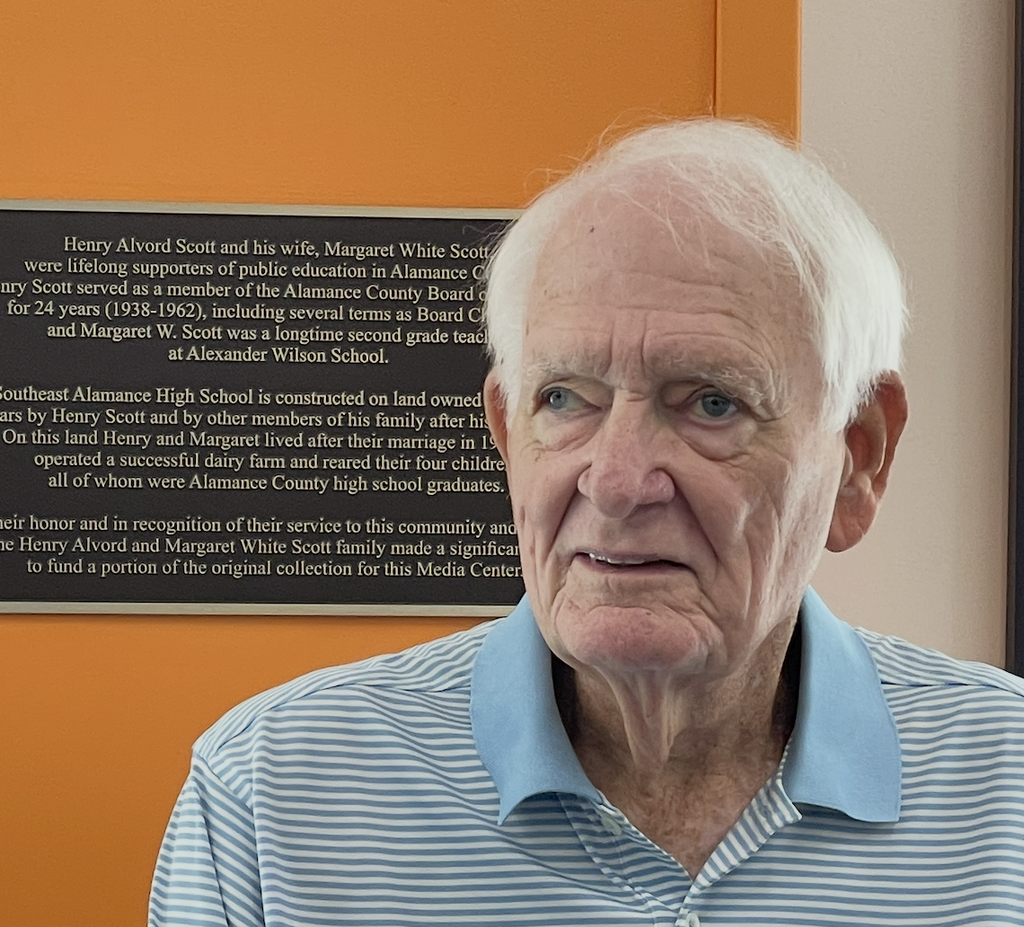
On Saturday, September 19, 2026, after a wonderful family reunion, members of the Scott family of Alamance County traveled 2.3 miles south on NC Highway 119 to visit a beautiful new school, Southeast High School. We gathered in the Media Center to view the plaque honoring Henry Alvord and Margaret White Scott for their contributions to public education in Alamance County, North Carolina. Henry and Margaret were both passionate about education and will be remembered for their many contributions to the children of our county. Their descendants have made a generous contribution to the Media Center at Southeast High School in Henry and Margaret’s honor. Erwin Fuller, (pictured here) who is married to their daughter, Nancy Scott Fuller, spoke at the event. The following is engraved on the plaque:
“Henry Alvord Scott and his wife, Margaret White Scott,
were lifelong supporters of public education in Alamance County.
Henry Scott served as a member of the Alamance County Board of Education
for 24 years (1938-1962), including several terms as Board Chairman,
and Margaret Scott was a longtime second grade teacher
at Alexander Wilson School.
Southeast Alamance High School is constructed on land owned for nearly
100 years by Henry Scott and by other members of his family after his death in 1962.
On this land Henry and Margaret lived after their marriage n 1925 and
operated a successful dairy farm and reared their four children,
all of whom were Alamance County high school graduates.
In their honor and in recognition of their service to this community and beyond,
the Henry Alvord and Margaret White Scott family made a significant gift
to fund a portion of the original collection for this Media Center.”
Ephemera, Posted on September 14, 2026
- September 15, 2026
- |
- Posted By: Scott Family Collection
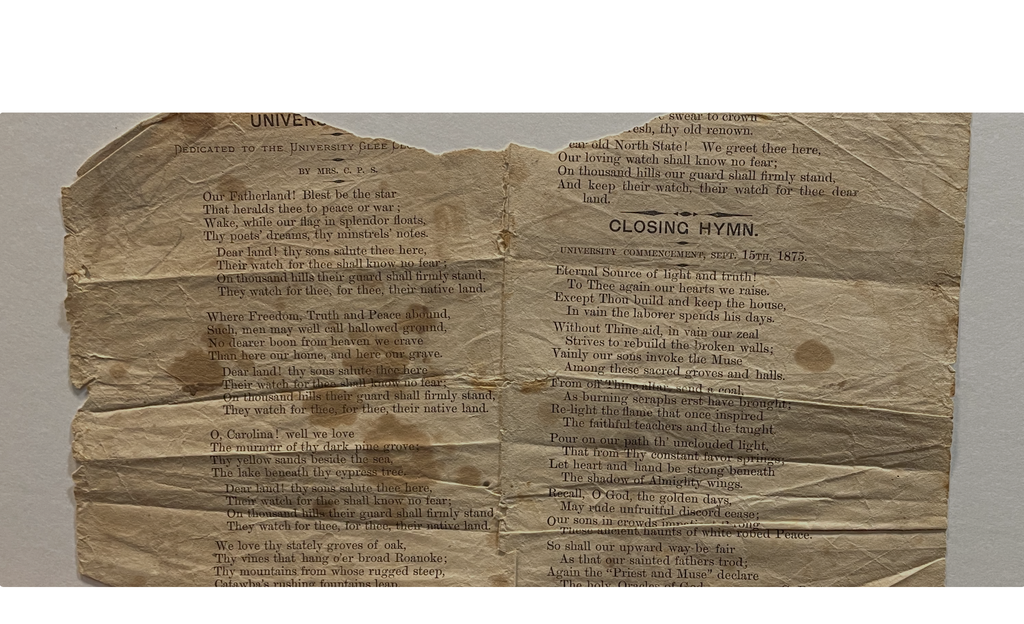
The term ephemera refers to a lot of things, but in the library world it refers to items that are deliberately transient, such as invitations, programs, brochures, flyers, and posters. Their use is intentionally temporary, and they are usually discarded after the event has taken place.
And yet we collect them anyway. They are a wonderful window into the day-to-day of a world gone by. In my world, a scrapbook is so much more valuable than a photo album, for the exact reason that the scrap book contains ephemera.
The word “ephemera” comes to us from the Greek, meaning lasting only a day.
This reminds me of a cartoon we have posted in the kitchen here at work. There is a drawing of a mayfly with the caption: Dang! I am only alive for one day and it has to be a Monday! And yes, in case you were wondering, one genus of mayfly is called Ephemera.
Well, the piece of ephemera pictured here is dated September 15, 1875, which was a Wednesday. I found it when going through a box of letters and printed items from the Hughes family. Lizzie Hughes married Robert Scott in 1883, and the rest is history. But back to ephemera.
At first I thought it was the program for the reopening of the University of North Carolina at Chapel Hill. The University closed for several years between 1871 and 1875, reopening in September of 1875. The reopening was referred to as a commencement. Now we use the term commencement for graduation at the end of the year. The next graduation for UNC would not be for a while!
This scrap of paper contains two hymns written by Cornelia Phillips Spencer, who urged the University to close during reconstruction after the Civil War, and who later urged its reopening. Cornelia is often referred to as, “The woman who rang the bell.” The bell in question was atop South Building. She must have been very brave to climb up there.
However, when I sent a copy of the item to the North Carolina collection, they could not find a match to any of their documents from the reopening.
So for now, the mystery continues . . .
Exonumia, Posted on June 18, 2026
- June 18, 2026
- |
- Posted By: Scott Family Collection
What in the world is exonumia?
Can you catch it?
Well, you might be susceptible if you already have a coin collection.
Exonumia refers to items such as tokens, political badges, commemorative medals, medallions and scrip. What they have in common is that they look like coins, but are not actually money.
The term was invented in 1960 by Russell Rulau, an authority on tokens.
The Scott Family Collection has quite a few examples of exonumia on display in the gallery.
Perhaps the most beautiful one is a medal awarded to W. Kerr Scott at his college graduation from what is now NC State University. This was back in 1917.
The medal pictured here was awarded for Best Oration. This makes sense in a foreshadowing sort of way. Kerr went on to be elected to public office and served North Carolina as Commissioner of Agriculture, Governor, and U. S. Senator. Kerr was well known for his energy and his ability to talk comfortably with all sorts of people.
