



What is an Indenture? Posted on January 28, 2026
- January 29, 2026
- |
- Posted By: Scott Family Collection

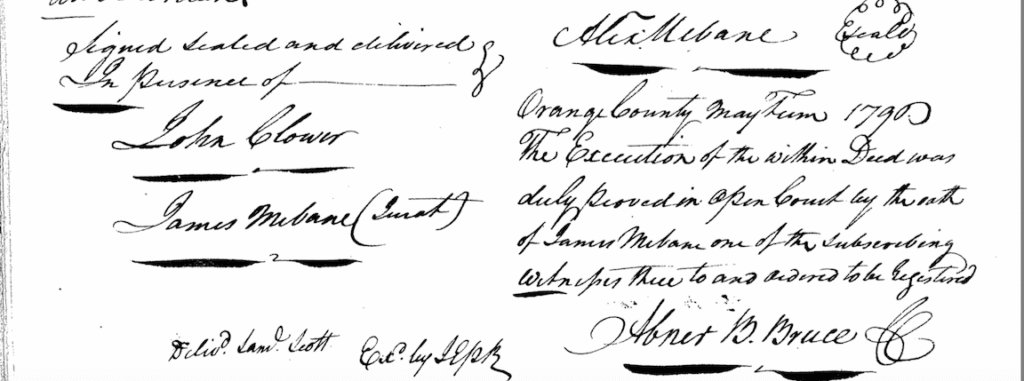
In the fall of 1793, Alexander Mebane and Samuel Scott signed an indenture in which Alexander sold 200 acres of land along the Haw River to Samuel. James Mebane was one of two witnesses to this transaction.
Here is a photo of the top of the document, which was entered into a bound volume at the County Clerk’s Office. The page number is visible at the top: 458. The bottom of the document shows who was present at the signing.
The word, “indenture” is not one we use all the time. When I looked it up, the definition was given as a legal agreement, contract, or document.
Samuel and James (the witness) were about the same age and most likely good friends by this time.
Because, less than a year later, when Samuel decided to get married, James stood up for him as bondsman.
The friendship must have endured, because years later, Samuel named one of his sons James Mebane Scott.
Guilty Pleasures, Posted on January 20, 2026
- January 20, 2026
- |
- Posted By: Scott Family Collection

One of the guilty pleasures afforded to historians is the chance to read the private correspondence and diaries of people who lived long ago.
Recently, I found a letter posted in December of 1945, while the United States was at war.
The letter was addressed to Mary Kerr (Mrs. John T. Kerr, Sr., 1864-1947). It was from her niece Gertrude who lived in Canada at the time.
The letter included an update on Mary’s brother (Gertrude’s father) who was in the hospital with a duodenal ulcer. Apparently, he was feeling much better and would be discharged soon. She suggested that if Mary wanted to cheer her brother up, some cigars would help. He was contemplating a vacation to Florida but didn’t want to go alone, she added.
Mary was expecting a lonely Christmas as her husband had passed away in 1940 and her son, John T. Kerr III was away in the Navy. So a trip to sunny Florida would be a nice diversion.
I wonder if Mary took the hint.
Button, Button, Who’s Got the Button? Posted on January 13, 2026
- January 13, 2026
- |
- Posted By: Scott Family Collection

I found this charming button in an antique secretary here at the Scott Family Collection. The button was attached to a small piece of paper indicating that the image is of John T. Kerr, Jr. who was born in 1898.
This button looks old timey now, but when it was made, such things were all the rage. The button was made by placing a small photograph on a metal backing and then covering it with clear celluloid. Celluloid was an early form of plastic, but not a true plastic, as the formula contained some organic material.
The secretary, a lovely pre-Civil War piece, was a bequest from John Jr.’s son, John Thomas Kerr III (1925-2021). I found the button and some lapel pins in one of the drawers.
The Kerr family and the Scott family are related through ancestors Nathaniel Greene Kerr and Margaret Graham (Barrett) Kerr. Nathaniel Greene Kerr was a patriot who served in the Revolutionary War. His grandson, John T. Kerr, settled in Durham and started a foundry.
John Thomas Kerr III was a college student when in 1945 he interrupted his studies to join the Navy. After his service, he finished his degree and then joined the family business, Durham Foundry & Machine Works. John had many interests but perhaps chief among them was his love for his family, his church, and Kerr family history. He was a charter member of the Saint Andrew’s Society of North Carolina and was very active in all things Kerr. Thank you, John!
The Girl Who Made the Cherry Pie, Posted on Monday, January 5, 2026
- January 5, 2026
- |
- Posted By: Scott Family Collection
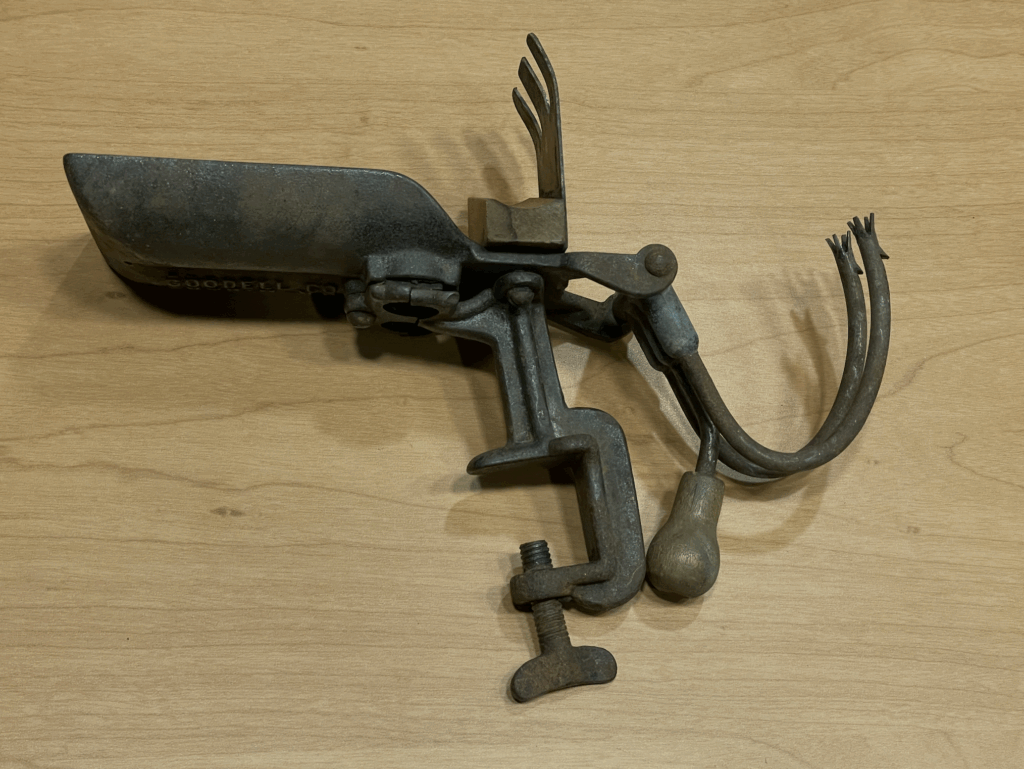
In June of 1936, Elizabeth Scott Carrington was working in Philadelphia as a nursing instructor. The Democratic National Convention was taking place nearby and she walked over to see if she could find someone her father knew, Josephus Daniels. Among other things, Mr. Daniels was the editor-in-chief of the News and Observer (Raleigh). She had met Mr. Daniels many years before when he came to her parents’ home for lunch one day.
She spotted Mr. Daniels right away and walked up to him. She introduced herself but before she could get more than a few words out, he interrupted her, saying, “You’re the girl who made the cherry pie!”
That must have been quite a pie. The cherries came from a Morello cherry tree on her parents’ property. Elizabeth said that she had never seen one anywhere else. The family also had a greenhouse where they grew their own lemons, but that is another story.
Elizabeth probably used the kitchen tool pictured here to remove the pits when she made the pie. Morello cherries are a medium sized cherry with a tart flavor and are excellent for baking and canning. I wonder if she made a lattice top for her pie. Elizabeth was known for her cooking and baking, and although she majored in Home Economics in college at Flora MacDonald, went off to nursing school in Philadelphia after graduation. And the rest, of course, is history.