


Ephemera, Posted on September 14, 2026
- September 15, 2026
- |
- Posted By: Scott Family Collection
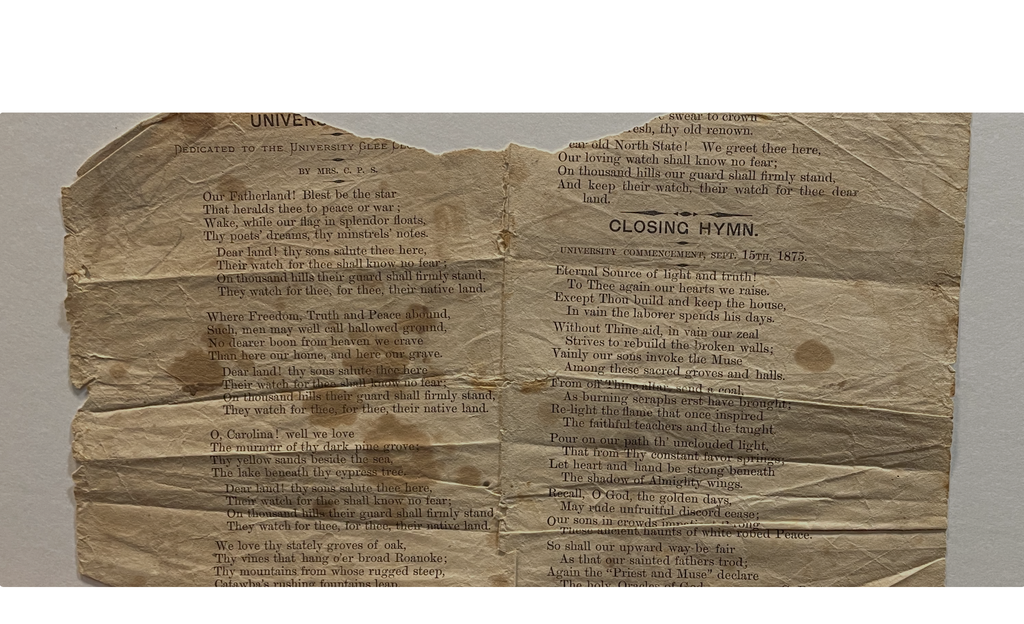
The term ephemera refers to a lot of things, but in the library world it refers to items that are deliberately transient, such as invitations, programs, brochures, flyers, and posters. Their use is intentionally temporary, and they are usually discarded after the event has taken place.
And yet we collect them anyway. They are a wonderful window into the day-to-day of a world gone by. In my world, a scrapbook is so much more valuable than a photo album, for the exact reason that the scrap book contains ephemera.
The word “ephemera” comes to us from the Greek, meaning lasting only a day.
This reminds me of a cartoon we have posted in the kitchen here at work. There is a drawing of a mayfly with the caption: Dang! I am only alive for one day and it has to be a Monday! And yes, in case you were wondering, one genus of mayfly is called Ephemera.
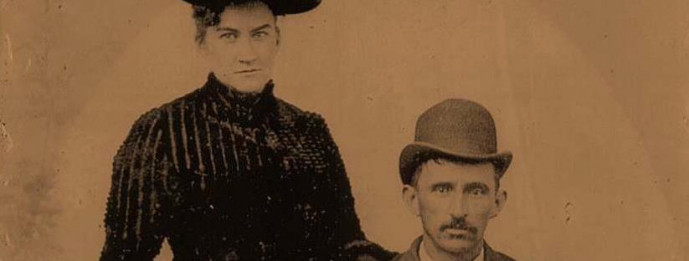
Well, the piece of ephemera pictured here is dated September 15, 1875, which was a Wednesday. I found it when going through a box of letters and printed items from the Hughes family. Lizzie Hughes married Robert Scott in 1883, and the rest is history. But back to ephemera.
At first I thought it was the program for the reopening of the University of North Carolina at Chapel Hill. The University closed for several years between 1871 and 1875, reopening in September of 1875. The reopening was referred to as a commencement. Now we use the term commencement for graduation at the end of the year. The next graduation for UNC would not be for a while!
This scrap of paper contains two hymns written by Cornelia Phillips Spencer, who urged the University to close during reconstruction after the Civil War, and who later urged its reopening. Cornelia is often referred to as, “The woman who rang the bell.” The bell in question was atop South Building. She must have been very brave to climb up there.
However, when I sent a copy of the item to the North Carolina collection, they could not find a match to any of their documents from the reopening.
So for now, the mystery continues . . .
Exonumia, Posted on June 18, 2026
- June 18, 2026
- |
- Posted By: Scott Family Collection
What in the world is exonumia?
Can you catch it?
Well, you might be susceptible if you already have a coin collection.
Exonumia refers to items such as tokens, political badges, commemorative medals, medallions and scrip. What they have in common is that they look like coins, but are not actually money.
The term was invented in 1960 by Russell Rulau, an authority on tokens.
The Scott Family Collection has quite a few examples of exonumia on display in the gallery.
Perhaps the most beautiful one is a medal awarded to W. Kerr Scott at his college graduation from what is now NC State University. This was back in 1917.
The medal pictured here was awarded for Best Oration. This makes sense in a foreshadowing sort of way. Kerr went on to be elected to public office and served North Carolina as Commissioner of Agriculture, Governor, and U. S. Senator. Kerr was well known for his energy and his ability to talk comfortably with all sorts of people.

Last Man Standing, Posted on June 3, 2026
- June 3, 2026
- |
- Posted By: Scott Family Collection

(Massachusetts Historical Society)
This ambrotype of Ralph Farnham was made in 1858 when he was 102 years old.
At that time, Ralph was one of the few remaining veterans of the Revolutionary War. He had enlisted in May of 1775, a few weeks before the Battle of Bunker Hill.
As is often the case, when the number of survivors of an historic event starts to dwindle, interest is generated for those that remain.
Ralph was written about and as he became more and more famous, he was credited with being the last survivor of the Battle of Bunker Hill. Not exactly.
As far as we know, Ralph did enlist a few weeks before Bunker Hill but was not engaged in that particular conflict. He never said that he was. We know about his war record from the pension application he filed in 1832.
Farnham did serve in subsequent campaigns, however, and he was a witness to British general John Burgoyne’s surrender at Saratoga in 1777.
Ralph left the Continental Army and returned home to Maine. He became a farmer, married a woman named Mehitabel Bean, and together they raised a family.
When invited to visit Boston for a celebration, Ralph Farnham wrote in reply, “I do not think I deserve any special credit to the part I took in the Revolution. I only felt and acted as others.”
Farnham nevertheless accepted the invitation and arrived in Boston on October 8, 1860.
On October 15, 1860, a concert was given in Farnham’s honor at the Tremont Temple. His visit to Boston coincided with a tour of the city by the Prince of Wales (the future Edward VII), and the Maine veteran briefly met with the young prince on 18 October.
Relative of Betsy Ross, Posted on May 18, 2026
- May 18, 2026
- |
- Posted By: Scott Family Collection

Image: tombstone of Ann Ross White, (1734-1819), Hawfields Presbyterian Church graveyard, Mebane, NC, the blue box surrounds the phrase, “Relative of Betsy Ross”
Have you ever watched any of those television shows where people find out about their ancestors? Sometimes the ancestor disappeared and the quest is to find them. Other times they have heard family lore that they are related to someone famous or even infamous!
Well, we have just such a mystery here in Alamance County. One of the tombstones in the graveyard of Hawfields Presbyterian Church reveals a surprising detail. On the tombstone of Ann Ross White (1734-1819) is inscribed: “Relative of Betsy Ross.”
What is interesting here is that Ann died in 1819, long before Betsy Ross became famous, although they were alive at the same time. It was not until 1870 that one of Betsy’s grandsons started promoting her significance.
So, what did Ann Ross White know that we don’t?
As it turns out, one of Ann’s daughters, Susan White, married Samuel Mebane. Samuel was either the nephew or cousin of Alexander Mebane, Jr.
In 1795, Alexander Mebane, Jr., then a widower, married Ann Claypoole. Ann was related to John Claypoole, who married Elizabeth Griscom Ross Ashburn, or Betsy Ross as we know her today.
Alexander died a few months after he married Ann Claypoole in Philadelphia but not before updating his will. His will provides for Ann and her return to Philadelphia after his death. If you want to learn more about the Claypooles of Philadelphia, consult Genealogy of the Claypoole Family of Philadelphia, 1588-1893, by Betsy’s granddaughter, Rebecca Irwin Graff.